
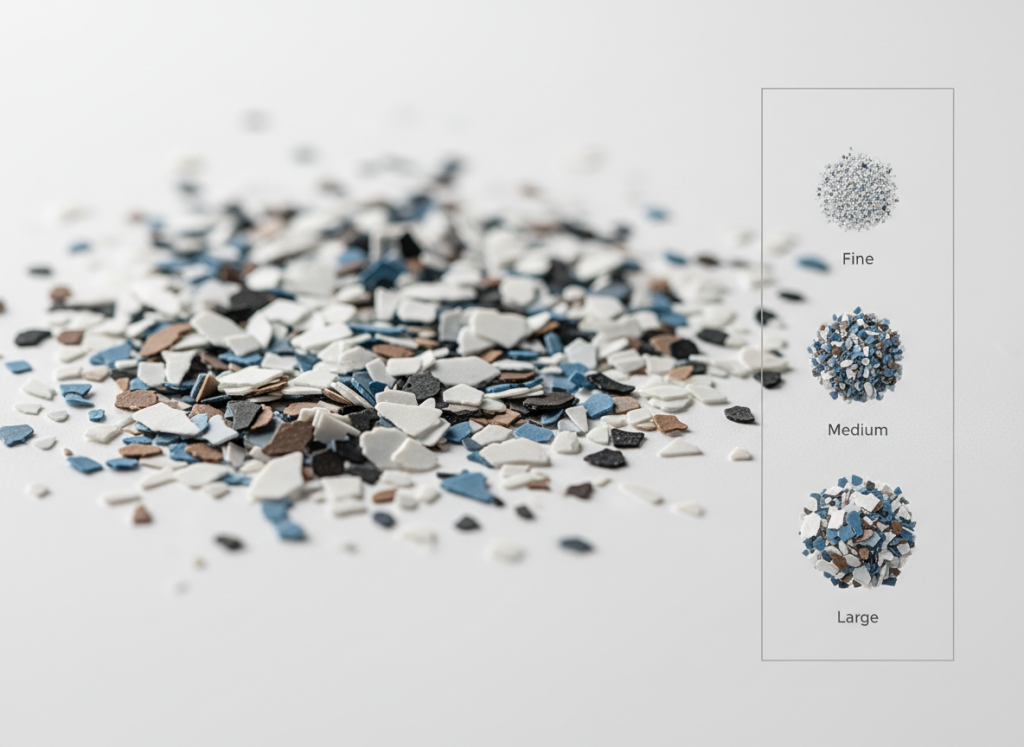
Vinyl flake chips (also called epoxy flakes or color flakes) are decorative polymer chips broadcast into a wet epoxy base coat. They add color, texture, and visual depth—then get sealed under a clear topcoat to create a durable, easy-to-clean floor.
They’re used in:
- Garage epoxy flake floors
- Shops and man caves
- Commercial back-of-house areas
- Light industrial spaces
Shop: Vinyl Flake Chips | Epoxy Flake Kits | Clear Topcoats
What Are Vinyl Flake Chips?
Vinyl flakes are thin, lightweight chips designed to:
- Create a consistent decorative finish
- Help hide small imperfections in the slab
- Add texture (and optional slip resistance when paired with the right topcoat/additive)
- Improve the “finished” look compared to solid-color epoxy
They’re typically broadcast at different densities depending on the look you want: partial flake or full flake.
Vinyl Flake Chip Sizes (And What They Look Like)
Flake size changes the pattern and how “busy” the floor looks.
Small Flake (Fine)
- Tighter, more uniform look
- Great for smaller spaces or modern styles
- Can look more “speckled” and consistent
Medium Flake (Most Common)
- Balanced look and coverage
- Works in most garages and commercial spaces
- Good blend of pattern + hiding power
Large Flake (Bold)
- More dramatic color pop
- Pattern looks more random and high-contrast
- Great for show garages and statement floors
If you tell me what sizes you sell (ex: 1/16″, 1/8″, 1/4“), I’ll rewrite this section to match your exact options.
Partial Flake vs Full Flake Coverage
Partial Flake (Light to Medium Broadcast)
Best for:
- Faster installs
- Lower material cost
- Decorative upgrade without a “solid flake” look
What it looks like:
- Base coat still visible between flakes
- More subtle texture
Full Flake (Heavy Broadcast)
Best for:
- Premium look
- Better hiding and more uniform appearance
- Higher traffic areas when built correctly
What it looks like:
- Flakes cover the surface edge-to-edge
- Base coat is mostly hidden
Full flake usually requires:
- Scrape + vacuum after cure
- A grout/build coat before the final clear topcoat
Coverage & Broadcast Rates (Planning Your Materials)
Coverage depends on:
- Flake size
- How heavy you broadcast
- How much waste you expect (full flake has more waste)
- Installer technique
Typical broadcast levels (simple planning)
- Light broadcast: decorative sprinkle, base coat clearly visible
- Medium broadcast: strong decorative coverage, base coat still shows
- Full broadcast: refusal / full flake coverage (surface fully covered)
If you want, give me:
- total square footage
- flake size
- partial vs full flake
…and I’ll produce a clean “you need X lbs” line for the page.
How to Broadcast Vinyl Flake Chips (Basic Process)
- Prep concrete correctly (clean + mechanically profiled)
- Apply epoxy base coat and keep a wet edge
- Broadcast flakes by hand or with a bucket method for even distribution
- Let cure fully
- Scrape high points and vacuum loose flakes
- Apply grout/build coat (common for full flake)
- Seal with a clear topcoat (often polyaspartic for UV + durability)
Choosing Flake Colors & Blends
When choosing a blend, consider:
- Dirt visibility: medium blends hide dirt best
- Lighting: lighter blends brighten a garage
- Consistency: high-contrast blends can show more pattern variation
- Match to walls/trim: neutral blends work with most spaces
Tip: If you’re selling blends, add a “Best Sellers” block with 6–12 blends and link each to the product page.
FAQs
Are vinyl flake chips the same as epoxy flakes?
Yes—most people use the terms interchangeably. The flakes are broadcast into epoxy, then sealed under a clear topcoat.
Do vinyl flakes make the floor slip resistant?
They can add texture, but true slip resistance usually comes from the full system design (flake density + topcoat + optional anti-slip additive).
Can I use vinyl flakes with polyaspartic?
Yes. A common system is epoxy base coat + vinyl flakes + polyaspartic clear topcoat.
Do I need a grout coat for flake floors?
For full flake systems, a grout/build coat is commonly used to lock down flake edges and create a smoother, sealed surface before the final clear coat.
Ready to Pick Your Flake?
Shop by:
- Color blends
- Flake size
- Coverage (partial vs full flake)